Do You Hold the Banister “Just in Case”? What That Little Habit Is Quietly Telling You About Your Knees
It isn’t your age, and it isn’t “just stiffness.” Pain researchers have a name for the slow cycle that turns small knee twinges into a smaller life. Here’s how to tell if it has already started, and the 90-second check that shows where you are in it.
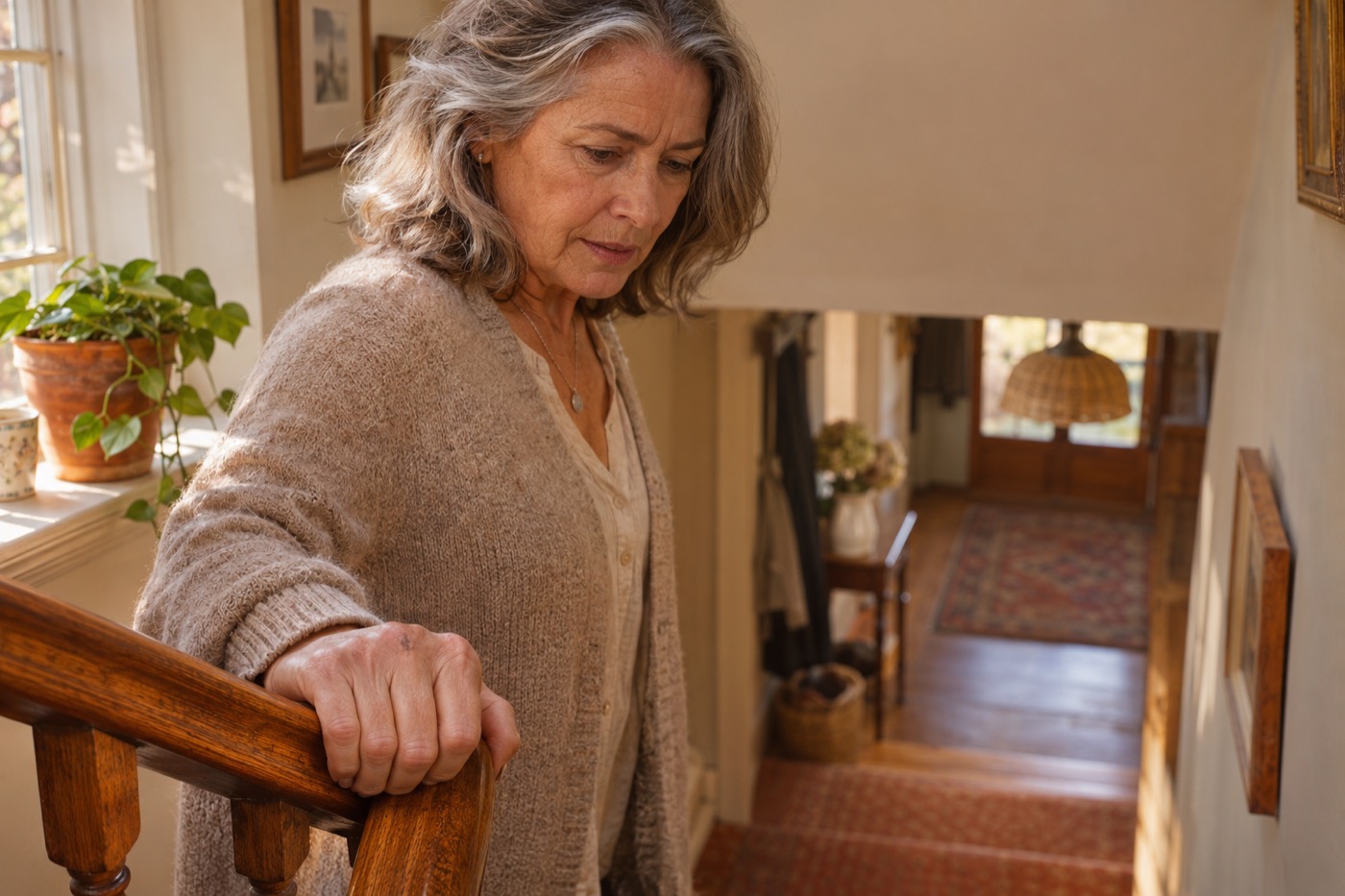
It starts so quietly that you would never call it a problem.
One morning, halfway down the stairs, you notice your hand is on the banister. Not because you need it. Just in case.
Then it’s the sofa. You start shuffling to the edge before you stand. The cupboard under the sink becomes a small operation: down carefully, back up slowly, one hand on the counter. And the first few steps out of bed take a little longer to feel normal than they used to.
None of it hurts much. None of it seems worth mentioning to the doctor, or even to your family.
And that is exactly what makes it so easy to miss.
The cycle nobody warns you about
Pain scientists have a name for what’s happening. They call it the fear-avoidance cycle.2 Once you see how it works, you can’t unsee it.
- A moment feels a bit harder.The stairs. The low sofa. Getting down to the floor.
- You work around it.A hand on the rail. A push off the armrest. “You go ahead, I’ll catch up.”
- The muscles behind that moment get less practice.And muscle that isn’t asked to work starts to fade.
- So the moment gets harder still.Which means more working around it, and the circle closes in a little tighter.
Here’s the cruel part: every single lap of the cycle feels sensible. Holding the rail is sensible. Choosing the higher chair is sensible. But each workaround quietly takes away a little more of the practice your knees depend on.
And the muscle that pays the price is the one doing the most important job of all.
The muscle that guards your knee
Every time you step down a stair, the big muscle on the front of your thigh, your quadriceps, works like a brake. It lowers your whole body weight, under control, one step at a time.
When that brake weakens, more of the load lands on the joint itself. Researchers who pooled the evidence found that people with weaker thigh muscles were more likely to go on to develop painful knee osteoarthritis.3
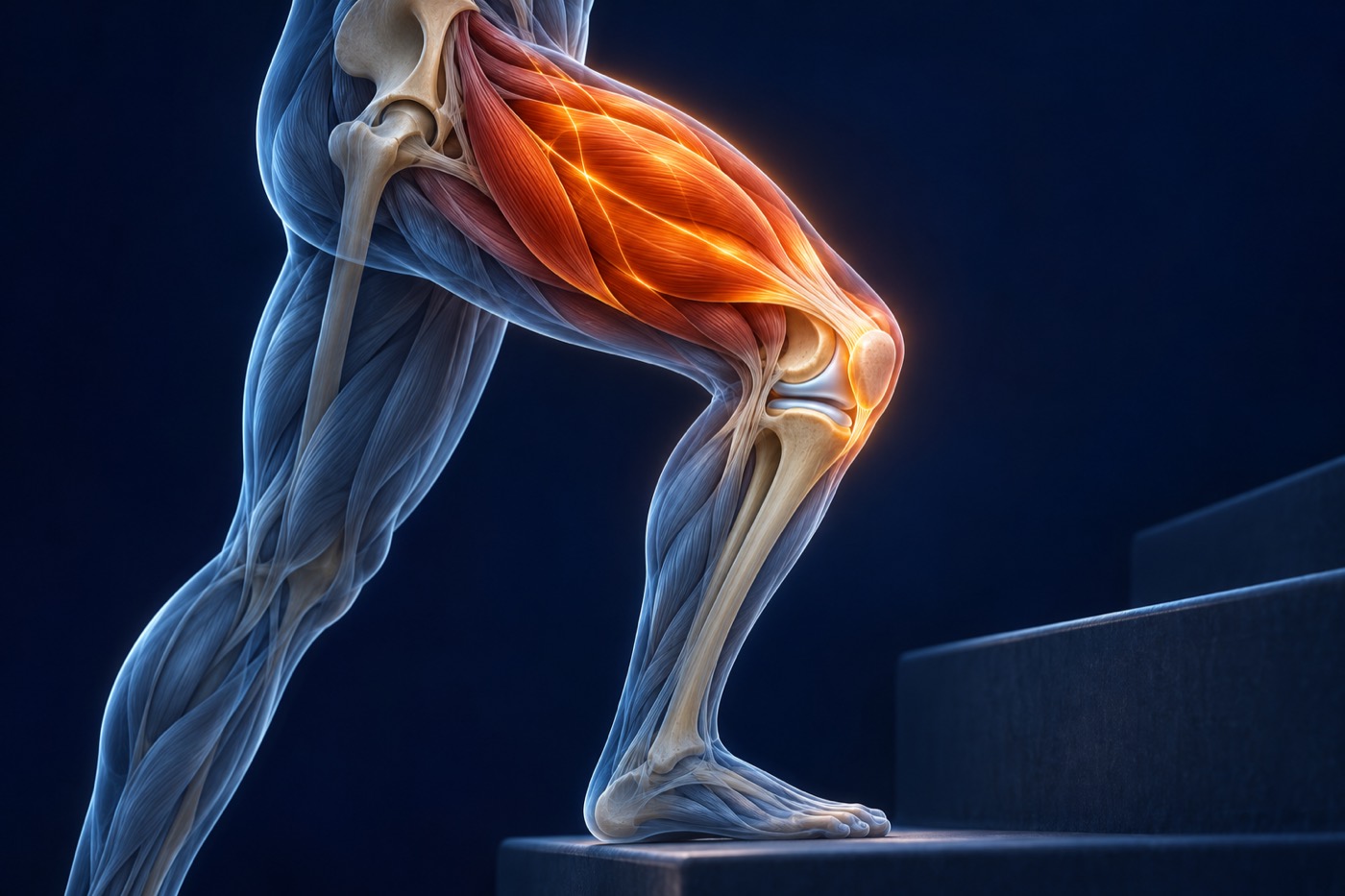
So how fast can that brake fade? Faster than almost anyone expects.
of knee-straightening strength lost by healthy older adults after just 10 days of bed rest.JAMA, 2007 4
of muscle mass lost every decade after 30, speeding up after 60, when it isn’t used.Clinical review 5
adults over 65 falls each year. Falling once doubles the chance of falling again.CDC 6
Read that first number again. Ten days. Not ten years. That is how quickly unused muscle begins to slip away. The avoidance cycle works like a slow-motion version of that bed rest, aimed squarely at the moments you’ve stopped practising.
Where the cycle leads if nothing changes
Nobody wakes up one day unable to manage the stairs. It happens in stages, each one so gradual it feels normal:
First, you change how you do things.
The rail. The armrest. The “good” leg first on every step.
Then you change what you do.
The longer walk gets skipped. The garden waits. You sit out the dance at the wedding.
Then you change where you go.
Restaurants without stairs. Friends’ houses with the “easy” chair. “You go ahead, I’ll meet you there.”
And one day, your own home feels like an obstacle course.
The stairs become a conversation. Then a brochure. Stairlifts. Bungalows. Your children quietly worrying about you.

But here’s what almost nobody tells you: the cycle runs in both directions.
Muscle never stops listening. In a landmark study published in JAMA, frail care-home residents aged 86 to 96 nearly tripled their leg strength in just eight weeks of regular, supervised strength training.7
If muscle still responds in your nineties, it hasn’t given up on you in your fifties, sixties or seventies. The same moments that have been shrinking can be practised back. The question is whether you start while they’re small.
Your knees carry far more than your weight
It’s tempting to think of this as a knee problem. It isn’t. It’s a life problem. Look at what is really riding on those two joints:
Your home
Staying in the house you love, stairs and all, on your own terms.
Your safety
Steady on stairs, kerbs and wet pavements, without the flash of fear.
Your grandchildren
Down on the floor for the block tower, and back up again without help.
Your partner
The slow dance at the wedding. The long walk together after dinner.
Your table
Standing at the stove for Sunday lunch. The stroll to the market and the café.
Your pace
Keeping up on the walk, not being the one who says “you go ahead.”
How you’re seen
Nobody noticing the hand on the rail, or the pause before you stand.
Your good years
More of them spent doing the things that make life feel like yours.

Why rest, leaflets and gym classes usually don’t stick
Here is something most people never hear from anyone. Every major clinical guideline for knee osteoarthritis, from the American College of Rheumatology to the international OARSI panel to the UK’s NICE, names the same first-line approach: regular exercise.8 Not as an extra. As the core.
So why doesn’t everybody just do it? Because the way it’s usually offered sets people up to quit.
The leaflet
Ten exercises, no idea which ones matter, folded into a drawer by Thursday.
The class
An hour, a drive, and a mat on the floor you can’t easily get down to, or back up from.
Resting it
Feels kind. But as you’ve just seen, rest is what makes the cycle spin faster.
Ten minutes you’ll actually do beats an hour you’ll skip.
What your knees need is the very moments they’re losing (bending all the way, straightening all the way, taking your weight as you stand) practised little and often, at a time that already exists in your day.
But first, you need to know where you’re starting from. And from the inside, that’s surprisingly hard to judge. Most people who are deep in the cycle still describe their knees as “fine, really.”
So, where are your knees in the cycle?
Where are your knees in the cycle?
Eight quick questions about everyday moments: the banister, the floor, the first steps out of bed. Your result shows where you are, and where ten minutes a day fits.
- About everyday moments, not your medical history
- No sign-up needed to see your result
- Honest: one of the results says you’re moving well and should keep doing what you do
Your five everyday moments are in. Three quick ones about you, and your result is ready.
Checking your answers…
Your routine
Have it looked at first
Meet Steady Ten: ten minutes a day for the moments you’ve started working around
Steady Ten is a guided daily routine on your phone, built around exactly the moments the check asks about: the stairs, the floor, the low chair, the first steps of the day and the longer walk.
- Your plan starts from your answers.Your hardest moment goes first, at your level, seated if you need.
- Open it at your time. Today’s 10 minutes are already chosen.Nothing to plan, nothing to decide. A reminder arrives at the time you pick.
- Follow along. No reading mid-move.Short, clear videos with large captions and calm spoken cues, plus easier and harder versions of every move.
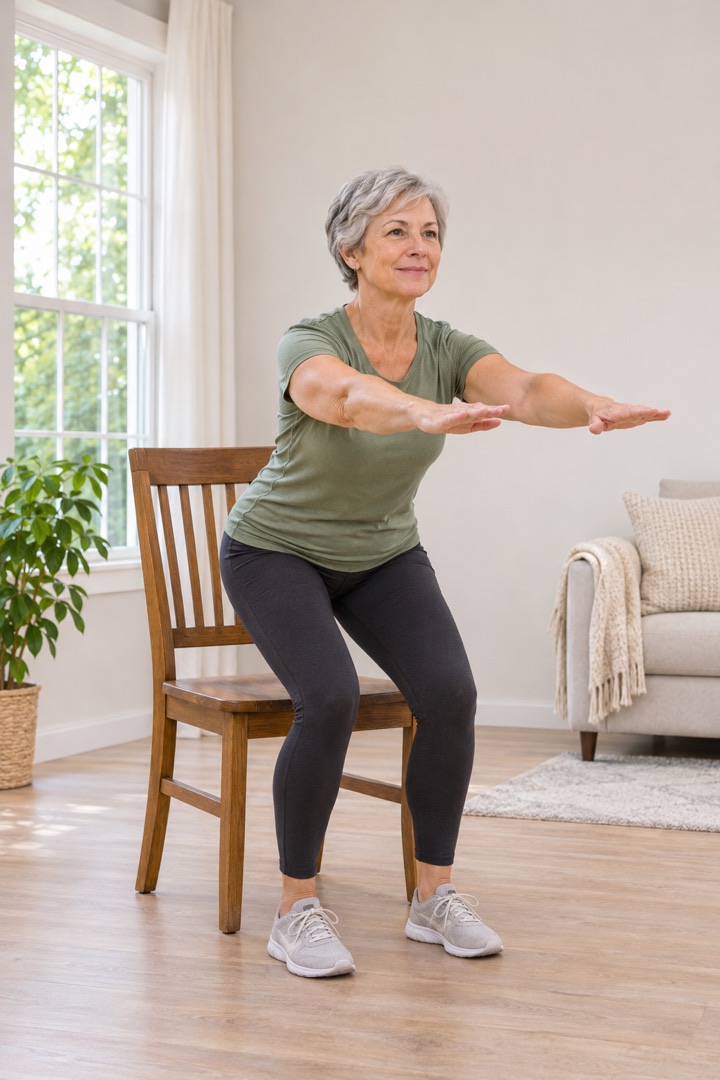
What every 10 minutes covers
Range
Slow bends and straightens, a little further than everyday life asks for, done next to the counter.
The muscles around the knee
Simple sit-to-stands and step practice with a sturdy chair or the counter, aimed at the moves stairs and chairs ask for.
The whole leg
The hip above and the ankle below are part of every step and stand, so the routine moves all three.
The remembering
The hard part is never the moves. Same time every day, with a reminder, built to be easy to keep.
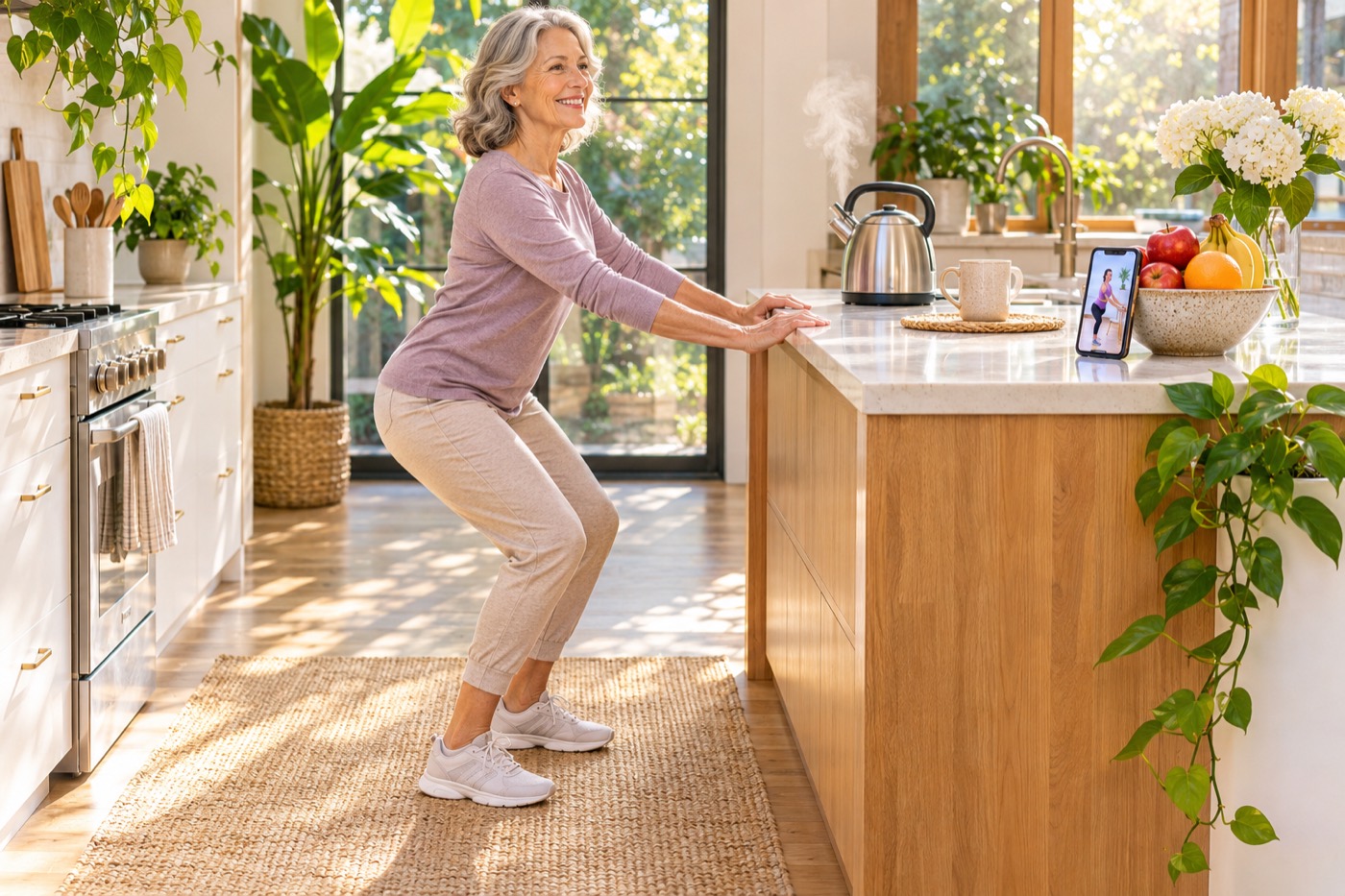
Starts where you are
Every move has an easier and a harder version, and seated options are built in. The first week is the same few moves each day, so the habit sticks before anything changes. A simple chart shows the days you showed up.Ten minutes a day for the moments that matter
A guided routine you follow along with on your phone, at a time that suits you. It starts at your level, builds a little each week, and every move can be done next to a chair.
- One guided 10-minute routine a day: follow-along video, large captions, calm spoken cues
- Built around your answers to the Everyday Knee Check
- Easier and harder versions of every move, seated options included
- A reminder at the time you choose
- A simple chart of the days you showed up
Steady Ten is a mobility routine for everyday comfort and function, not a medical treatment.
Your plan is built from your answers
Take the 90-second Everyday Knee Check and your personal 10-minute plan unlocks right here, starting with the moment you find hardest.
Questions people ask before they start
I’ve tried exercises before and didn’t stick with them. Why would this be different?
I can’t get down on the floor. Can I still do it?
Do I need any equipment?
Am I too old for this to make a difference?
Is it safe?
Is Steady Ten a medical treatment?
What does it cost?
Two versions of the next five years
The cycle doesn’t stand still. It turns one way or the other, a little every week. Which way is decided by the small, ordinary minutes in your day.
If nothing changes
- –The rail goes from “just in case” to “can’t without it.”
- –The floor becomes somewhere you simply don’t go.
- –Walks get shorter, then rarer.
- –Your world gets a little smaller every year.
Ten minutes a day
- +The stairs stay just stairs.
- +You get down to the grandchildren, and back up.
- +You keep up on the walk.
- +You stay in the home you love, on your terms.
P.S. Remember the number: ten days. That’s how quickly unused muscle starts to slip. The best day to start practising the moments you’ve been working around is the day you notice them. For you, that might be today.